ApeosPro C Series

C810, C750 & C650 – Light production printers offering exceptional quality

High quality light production printers

At home in a corporate office, light production professional print environment, or design agency

The ApeosPro C Series is an entry level range of four-colour printers that offer exceptional quality for businesses with lower production volumes. They are built on a next-generation platform, with all printers in the range able to produce superb, high quality print on a wide range of substrates and for a wide range of applications.

Superb

2400 x 2400 dpi

print quality
Print speed

Up to 81 ppm

Full colour
Paper weight

52 to 350 gsm

Bypass tray

Why ApeosPro C Series?

World’s first LED printhead with 2400 x 2400 dpi resolution

Versatile enough to print a wide range of applications

High productivity levels with continuous operation

Interface Decurler
Inserter D1
High Capacity Stacker A1
Crease / Two-sided Trimmer D2
Folder Unit CD2
Finisher D6 / Finisher D6 with Booklet Maker
Square Back Trimmer D1

Ultra-high quality output

The ApeosPro C Series benefits from the world’s first high resolution LED printhead, which produces incredible, high definition print. It is also possible to maintain high print quality levels with very simple adjustments.

The world’s first* high resolution LED printhead

  • 2400 x 2400 dpi resolution
  • LED printhead produces a very thin LED beam to write the image
  • The exposure unit does not vibrate because there is no drive mechanism, meaning image reproduction is incredibly stable
  • The LED printhead consumes less energy, resulting in lower power consumption

* Utilising dry-electrophotographic toner, as of March 2021 and according to Fujifilm research.

Suitable for a wide variety of paper sizes and thicknesses

The ApeosPro C Series printers are able to print on a wide range of paper sizes and thicknesses, making them suitable for the production of many different types of print.

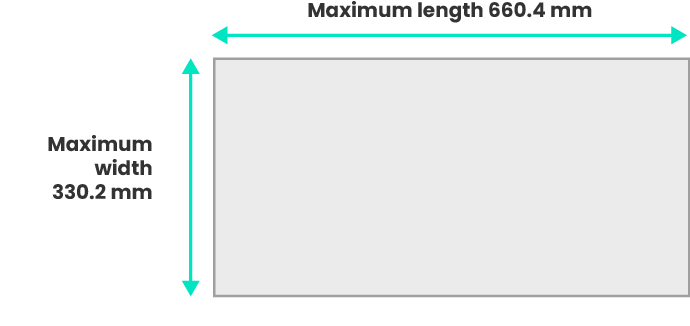
  • Suitable for paper sizes from postcards to long sheets of paper, up to a maximum size of
    330 x 1300 mm
  • Supports a wide range of thicknesses from 52 gsm lightweight paper to 350 gsm cardstock paper
  • Prints beautifully, even on envelopes and embossed paper with an uneven surface

Advanced security features

Information is an important asset which should be protected at all cost. The ApeosPro C Series printers incorporate a range of security features to safeguard important information.

  • User authentication and permissions
  • Protection against unauthorised access to higher level management functions
  • Protection against software misuse
  • Encryption of documents stored on the printer, and communication data between printer
    and PC
  • Prevention of issues caused by operator errors

High productivity levels with continuous operation

The ApeosPro C Series printers offer excellent durability and high productivity levels with continuous operation possible.

  • Achieve print speeds as high as 81 x A4 ppm with the C810, 75 ppm with the C750, and
    65 ppm with the C650
  • High capacity paper feeder holds up to 7360 sheets*
  • It is possible to replace toner cartridges and add paper without stopping the print job in progress, therefore maximising printer uptime and productivity
  •  Low wear photoconductor drum with long life reduces the frequency of drum replacements

Stable paper feed, whatever the substrate type

The ApeosPro C Series printers are incredibly versatile, thanks to a number of key features:

  • A built-in sensor detects any misalignment of paper traveling at high speeds andautomatically corrects it
  • By adjusting the force applied to the paper according to the paper thickness, a stable paper feed and high registration accuracy are achieved, even with thicker cardstock
  • A built-in decurler flattens any possible paper curl, which helps guarantee the stable feed of paper. In addition, as an option, the printers can monitor any paper curl that is present, and make adjustments in real time to further minimise any potential paper feed inconsistencies.
  • The optimum output conditions for each paper type, such as the
    transfer conditions, can be registered and stored (maximum: 100)
    so that high quality output can be achieved efficiently simply by selecting the correct paper type.

See for yourself..

See what the ApeosPro C Series can do for your business

Watch the video

Request a sample

See the quality you could achieve with the ApeosPro C Series

Finishing applications

Versatile post-processing with a range of in-line finishing options

From printing to post-processing, the ApeosPro printers are incredibly versatile, making it possible to produce many different types of finished print.

Square Back

High quality booklets with a square back finish for a flat book spine.

Crease

Crease function to create unique accordion folds for promotional materials. Up to five creases can be made for mountain and valley folds.

Discover more

Learn more about the ApeosPro C Series by downloading the product brochure

Download the brochure

Case study – Emmerson Press

Emmerson Press becomes the first UK print business to invest in Fujifilm’s innovative ApeosPro C810 toner press.

Read more here

Case Study: Revoria Press PC1120

Floricolor

Case Study

Floricolor expands business offering and increases revenue with investment in Fujifilm Revoria PC1120

Floricolor

Perafita, Portugal

Revoria Press PC1120

There are many ongoing challenges in the market, but Fujifilm is always a reliable partner that has enabled us to overcome these challenges and help us to grow

Tiago Yu | Floricolor

Highlights

  • Floricolor is one of the leading producers of professional photography albums in the world
  • The company has had a Jet Press 750S since October 2019 – the company’s largest investment
  • Now, Floricolor has invested in the Revoria PC1120, enabling the company to produce wedding invitations
  • Floricolor has been impressed with the special colours, effects, textures, sizes and substrates that the Revoria can print on
  • The designers and photographers have also been impressed with what can be achieved.
  • Revoria investment marks the latest step in a successful long-term partnership

Floricolor celebrated its investment in Fujifilm’s Revoria PC1120 press with an open house event in March 2022. Inviting several Portuguese customers, Floricolor and Fujifilm demonstrated the full potential of the new Revoria press – working in tandem with the Jet Press 750S – with printed samples and live demonstrations.

“The open house presented an initial opportunity for us to showcase what the Revoria can achieve, as well as giving our customers a chance to provide feedback.” explains Tiago Yu, CEO, Floricolor. “They were all very impressed with the results and what can be achieved so we knew exciting times lie ahead.”

“Our main market used to be wedding albums, but in recent years we’ve seen the demand for this service decrease. Demand for wedding invitations, however, is still just as strong, so we saw an opportunity to compensate for this loss in wedding album production by entering the wedding invitation space, something which has only been possible with the investment in the Revoria press. It also enables us to print large wedding album covers that we were previously not able to, helping us to expand our product offering and increase our revenue.”

“With the Revoria PC1120, we have launched a new business venture named Studio 6. Under the Studio 6 brand, we print wedding invitations, thank you cards, business cards and special stationery for our customers. We use the PC1120, in combination with other finishing equipment, to offer our customers a range of unique products, using special colours such as gold and silver varnishes.”

“The designers have been very impressed with the results that can be achieved from the Revoria press, particularly the special colours, textures and different substrates. Typically, it would be difficult to achieve a small run order of special colours, but with the Revoria PC1120, we are now able to do just that. All of our customers have been amazed with the quality and turnaround times.”

In addition to the special colours, the PC1120 enables us to print on substrates of many thicknesses, sizes and types, including plastic – something that we could not achieve with any comparable press on the market. The machine’s media handling is also particularly impressive.

Tiago Yu | Floricolor

“There are many ongoing challenges in the market, but Fujifilm is always a reliable partner that has enabled us to overcome these challenges and help us to grow. We have immense confidence in them to help us deliver print of the highest standard and we are looking forward to continuing to develop this relationship in the future.”

Watch the video

Revoria Press PC1120

Find out more about the award-winning features of the Revoria Press PC1120

Discover the Revoria Press PC1120

Discover more…

Learn more about the Revoria Press PC1120 by downloading our product brochure.

Download the Brochure

Case Study: Jet Press 750S HSM & Revoria Press PC1120

Wegner

Case Study

German photographer produces stunning photo book with a combination of Fujifilm inkjet and toner technology

Wegner GmbH

Bremen, Germany

Jet Press 750S HSM & Revoria Press PC1120

We are glad we invested in both the Jet Press and the Revoria, which together made this project possible.

Henning Rose | Wegner Gmbh

Highlights

  • Successful independent photographer Gisela Schäper needed a short run of copies of her book printed at an extremely high standard of quality
  • Her book was to accompany a major exhibition, marking the culmination of a 10-year project
  • She initially turned to a well-known offset printer, to ensure the highest quality
  • When the results fell short of her expectations, she explored other options and was referred to Fujifilm customer, Wegner GmbH
  • Henning Rose at Wegner used the Jet Press 750S to digitally print the book and the Revoria Press PC1120 to produce the cover with special effects
  • The finished result exceeded Ms Schäper’s expectations

Gisela Schäper is a successful independent photographer and graphic designer based in Münster, North Rhine-Westphalia, Germany. For the last ten years, she has worked on an extensive project compiling an impressive portfolio of dimly-lit photographs of castles, palaces and cellars. After building up her extensive collection, she planned a solo exhibition, entitled ‘Castle Whispers’, to showcase the photographs, after receiving sponsorship from the German government. Gisela also wanted to present the photographs in a high quality photobook to accompany the exhibition.
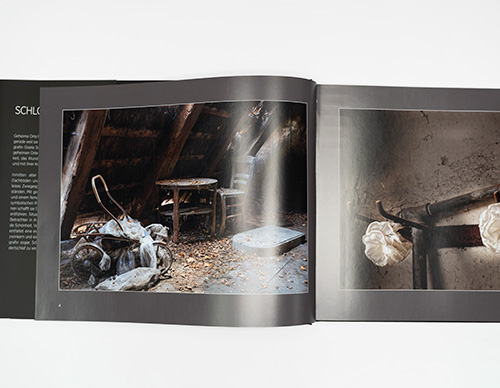
“I selected a well-known printing company to produce the book,” explains Gisela. “They recommended offset printing to achieve the best quality but, when I reviewed the proofs, the results were disappointing. The grey areas behind the pictures were not of the quality I desired, and for me, the grey areas were crucial, as they represented the atmosphere of mystery I was trying to capture in all those locations. In addition, there was a small white border line around the pictures that had not printed as I’d envisioned, and some printed areas were rough to the touch. Unfortunately, the offset press was simply not able to achieve the result I desired, no matter how many refinements the printer made, so I sadly came to accept that the book would not be able to be present at my exhibition.”

Close to giving up, Gisela’s husband was searching the internet and came across Fujifilm. “I contacted Fujifilm and explained my dilemma.” Gisela continues. “Fujifilm promptly put me in touch with Mr. Rose, CEO of Wegner GmbH. I explained my needs to Mr. Rose, and he reassured me that he could help and offered a test print. I sent him the book files, and to my surprise, he sent back the entire book printed. I was amazed by the result.”

Long-term Fujifilm customer, Henning Rose, CEO of Wegner, turned to the Jet Press 750S to print the sample of the book, which he has had installed since August 2019. He also used the Revoria Press PC1120, installed in March 2022, to print the cover of the book with special effects.

“After some small requested refinements, the final result was better than I could have hoped for.” Gisela continues. “The grey area behind the pictures was even and precise, the small white lines were printed perfectly, and the quality of the photos was excellent and sharp. I was also very impressed with the cover with the soft touch foil.”

“I was delighted to have the book available for my exhibition, printed to the high standard I had always wanted. In retrospect, I am grateful that the offset printer was not able to print my book. Otherwise, I would not have been introduced to Fujifilm and Wegner.”

Henning Rose, CEO, Wegner GmbH reflects on the project. “As soon as Gisela came to me with her query, I was confident that we could deliver the results she needed, using the Jet Press and Revoria Press PC1120. The Jet Press was used as it is ideal for the level of quality, precision and attention to detail the book required.

“In addition, the Revoria press was able to achieve the special effects on the cover, thanks to the PC1120’s ability to print metallic colours – an extra touch that Gisela was delighted with. The longer format size of the cover would also not have been possible on any other press. We are glad we invested in both the Jet Press and the Revoria, which together made this project possible.

“It was a pleasure to work with Gisela on this project and we were glad that we could help bring her vision to life, and that she did not have to give up on this project. It’s moments like this that are truly rewarding and demonstrate the value that we can provide to customers, in combination with Fujifilm, our long-standing partner.”

Revoria Press PC1120

Find out more about the award-winning features of the Revoria Press PC1120

Discover the Revoria Press PC1120

Imprinting Systems

Scalable solutions for a diverse range of applications

Add digital to your analogue process

Scalable set of imprinting solutions based on industry-leading Samba printbars

Fujifilm’s imprinting solutions allow digital inkjet printing to be integrated directly onto existing analogue production lines for a broad range of printing and industrial applications.

Industry-leading

Samba

printbar technology
Versatile

ink

configurations
Robust and

ultra-reliable

technologies

Why Fujifilm Imprinting Solutions?

Samba delivers ultra-high quality & reliable performance, with minimal waste

Fujifilm technologies designed to work together for optimum system performance

We engineer a bespoke solution designed to fit your production process

Integration into your production process
Global Fujifilm support
Industry-leading Samba printheads
Versatile ink capability
Fujifilm technologies integrated into your process
Scalable architecture

Compared with our legacy system, the Fujifilm imprinting system gives us more up-time, shorter set-up times and results in far less waste.

Bernd Wein | Paragon Germany

Read case study

Request a demo

See for yourself how our imprinting systems can add value to your business

A secure investment in proven imprinting technologies

Fujifilm is unique in that it integrates core inkjet technologies that it has developed in-house, rather than being an integrator accessing third-party technologies. This means that Fujifilm’s printhead designers, ink technologists and integration specialists work together to ensure optimum system performance and reliability for the required application, and once built, are able to take ownership of the complete solution.

What sets Fujifilm apart?

What sets Fujifilm apart are the industry leading printheads and ink at the heart of the company’s imprinting solutions. Samba printheads are found in many of the industry’s leading digital printing systems, as they combine the very highest quality, productivity and reliability, with the flexibility to be used with a variety of different inks and fluids. Fujifilm has now built these printheads into a number of scalable printbar configurations which, when combined with Fujifilm’s own UV or aqueous ink technologies, result in best-in-class imprinting solutions.

Fujifilm can therefore provide all components necessary to successfully integrate a digital solution into an existing production line:

  • Printhead & printbar design
  • Inks & substrates
  • Electronics & software
  • Print systems
  • Transport systems


A bespoke solution for your production process

Fujifilm’s approach is critical to ensure that any imprinting system can be configured to meet specific application requirements. This is achieved by a dedicated team of multi-discipline engineers working together to understand the print performance demands and production process. This then results in a specification for a system configuration that delivers exactly what is needed, including attributes like print width, print quality, colour channels, pre- and post-treatment, printed product performance and regulation compliance.

Fujifilm’s engineers consider all aspects of imprinting performance:

  • Ink and printhead selection
  • Ink performance optimisation
  • Ink in head on paper testing (developing robust image modes)
  • System design & integration
  • Highly skilled trouble shooting & integration expertise with direct access to the people who designed the relevant component
  • Accessory technology selections (pre-treat, post-treat, curing, drying etc.)
  • Full technical ownership of the solution – as Fujifilm supplies all component parts
  • Engineering capability

Samba – the heart of Fujifilm imprinting systems

The jetting of ink onto paper is a well established process in consumer printers, but scaling up the technology to meet the quality and productivity needs of industrial printing is not easy. Fujifilm’s answer is Samba – a ‘printhead on a chip’. This printhead is fabricated on silicon wafers, in much the same way large scale integrated circuits found in computers are made. Due to its scalable design, Samba enables individual printheads to be placed close to each other to form single, tightly integrated printbars.

Samba is a quantum leap forward and is redefining how inkjet technology is designed, manufactured and applied. It is the first piezo drop-on-demand inkjet platform that truly delivers wide-width, high resolution, single pass inkjet printing without the typical trade offs in quality, redundancy or print width.

High uptime and reliability for excellent total cost of ownership
The silicon MEMS design of a Samba printhead is rated for trillions of actuations to ensure reliable and profitable operation. This is coupled with a patented REDIJET® ink recirculation system. This system ensures that ink is constantly recirculating in a closed loop that will not disrupt printing, resulting in uninterrupted production. When coupled with a Fujifilm ink in an imprinting system designed to leverage this capability, it results in fast startup times, simplified printhead cleaning procedures, and consistent print quality.

Samba printhead life is measured in years, not hours, and in Fujifilm printbar systems, is not considered a consumables part. Ultimately, the design of Samba printbars means there is less production waste, lower ink consumption, and lower operating costs.

Benefits of Samba

  • Ultra-high resolution ink deposition
  • Rated for trillions of actuations for ultra-high reliability
  • Closed loop ink recirculation for uninterrupted production
  • Fast start-up times and minimal printhead cleaning and refurbishment
  • Suitable for multiple fluid types

Scalable architecture design

Fujifilm’s Samba technology platform is based on a scalable architecture design, so the print width can be configured to meet the needs of a particular application. And due to the trapezoidal design of Samba printheads, scaling the printbar width is achieved with no compromise to quality, which results in an efficient system design. In addition, the scalable system architecture means integrated components, electronic systems and software can all be scaled to create a system for the print width and colour channels required.

From single printhead to complex multichannel configuration
Printbar configurations can be scaled from a single printhead, single colour system for coding, language changes or simple promotional versioning, to a printbar system with multiple printheads for the printing of full colour images over wider print areas.

Wide ranging Samba printbar portfolio for any print width in 40mm increments

  • Monochrome, spot colour, process colours
  • Imprinting lanes or full digital print
  • Digitise existing analogue assets

Mini 4300 Series: versatile printbar system

The Mini 4300 has speed, performance and consistency in a compact form. This enables the incorporation of digital printing into an ever-expanding number of new applications and challenging conditions for equipment integration.

Key features

  • Single pass inkjet imprinting system
  • Each printbar contains a single 1.6” width printhead (40 mm)
  • Up to 4 printbars per system
  • 1200 dpi native resolution
  • Speeds up to 1000 feet per minute
  • Monochrome, Spot colour or 4-Colour
  • Aqueous & UV

Flexibility for a broad range of markets
The Mini 4300 is configurable with up to four individually controlled printbars. The system provides single pass printing in monochrome or process colour for a wide variety of production applications, including:

  • Addressing
  • Coding & marking
  • Serialisation & package tracking
  • Narrow width direct mail imprinting
  • Consumer facing coding
  • Variable data images
  • Demonstrations
  • Tickets and cards
  • Short notice changes in art/imagery
  • Printed electronics
  • Deposition of high-value fluids
  • Labels

X-BAR: drop-in imprinting solution

The X-BAR system’s drop on demand inkjet printing is reliable, cost effective, and provides excellent image quality in font sizes as small as 2 point and 1D barcodes as small as 6.7 mils. It is compatible with legacy systems and is backed by Fujifilm’s world-class technical support, to provide a smooth transition to modern inkjet technology for direct mail, transactional print, promotional materials and more.

Key features

  • Lane printing with 4.5” and 9” print width offerings
  • Controller capable of running X-BAR and some existing legacy printers
  • Workflow based on IJPDS page description language
  • No refurbishment needed
  • Familiar user interface to support transition from legacy technology
  • Modular fluid management for future expansion

12K Printbar: compact printbar system

The 12K Printbar System puts 4 colour inkjet printing technology into an all-new
condensed form. It supports use where space is limited, such as integrating into
existing production equipment.

The 12K Printbar System is a turnkey digital inkjet printing system for installation onto your analogue printing press or other production line equipment. It is most commonly used for adding variable data to analogue pre-printed shells (imprinting) or can be
used to add a digital print capability when changing printing plates is not practical for short runs. It has a print width of 127 mm, and provides 1200 dpi, 4-colour inkjet print. The printbars occupy only 53.3 cm in the print process direction, with their small size meaning digital inkjet printing can be added to many types of production lines where it was previously impractical.

Key applications
The 12K Printbar System can be used in a wide variety of applications, including:
• Commercial printing
• Direct Mail
• Transactional
• Folding Cartons
• Corrugated

42K Printbar: scalable printbar system

The 42K Printbar System is designed to add variable data printing to your conventional press in any print width needed, and is able to span the media from edge to edge. It uses Fujifilm’s renowned Samba printhead in a highly configurable form. With 1200 dpi ink deposition, the 42K Printbar system is designed to meet print requirements from single page to multiple pages in any print width needed, and with print speeds over 300 metres per minute.

Flexibility
Since the 42K System can be integrated in line with your system, you can maximise your productivity and return on investment while supporting existing, legacy or proprietary workflows. These will be integrated into our print controller and fluid management technologies to deliver a compact and capable system designed to meet your needs for monochrome, colour, or speciality printing.

Key features

  • Modular design to meet typical press widths
  • Pre aligned to eliminate stitching
  • Options for monochrome, spot and process colour printing
  • Configurable software with Fujifilm supplied workflow or connect to an existing customer workflow
  • No refurbishment needed
  • Imprint or full digital print capability

Applications

Use digital inkjet to enhance your production

There are opportunities for Fujifilm’s range of imprinting printbars to be integrated on many different types of production equipment, and whatever the format. This makes it possible for many different applications to be enhanced by digital inkjet, from direct mail and transactional applications in commercial printing, to label, packaging and industrial production processes.

Commercial print

Direct mail

Transactional print

Packaging

Industrial

Discover more…

Learn more about Imprinting Systems by downloading our product brochure.

Download the brochure

Digital print technology for a circular economy

This white paper has been published by Fujifilm as part of its commitment to deliver technically advanced and sustainable printing solutions for the print industry

Read the white paper

Reading time: 3 minutes

Where does print fit in the circular economy?

From books, newspapers, magazines and brochures to folders, annual reports and packaging, print remains a vital and highly effective branding, marketing and communications tool. But in an age of heightened environmental concern and ‘net zero’ carbon reduction targets, how can print be used in the most efficient and responsible way? In this white paper, we take a look at how the latest digital printing technology is dramatically cutting waste and making recycling much easier.

Download white paper

Fill out the form to download the full 12 page White Paper

We must do more

As part of the “European Green Deal” project, there is an action plan for the EU to boost the efficient use of resources by moving to a clean, circular economy, restore biodiversity and cut pollution, and be climate neutral by 2050. To achieve this goal, action must be taken at all levels. Switching to renewable energy will, on its own, reduce global greenhouse gas emissions by only 55%. The remaining 45% of emissions come from the way we make and use products, which means working smarter and wasting less.

Fujifilm is committed to fully integrating print into the circular economy. Net zero doesn’t have to mean online only – print will always have a vital role to play, and we’re committed to making sure it can always play that role efficiently, effectively and sustainably.

The way we print is changing

The graphics industry has many analogue techniques which, especially when used for bespoke or short run work, have an enormous impact on the environment.

Now, thanks to the latest developments in digital print technology, there are machines which can print while also:

• Massively reducing raw material use
• Using fewer and more sustainable consumables
• Needing far fewer parts replacing
• Producing less waste
• Consuming less water
• Producing 100% recyclable printed products

This technology is moving print from the linear to the circular economy in which everyone has a role to play in keeping our planet liveable and our prosperity intact.

Revoria PC1120 wins BLI 2022 Pro Award

Triumph for Fujifilm as Revoria Press PC1120 Wins Buyers Lab 2022 Pro Award

Read the article

Reading time: 3 minutes

Fujifilm’s new Revoria Press PC1120 recently earned the Keypoint Intelligence ‘Buyers Lab 2022 Pro Award’ in the ‘Outstanding High-Volume CMYK+ Production Device’ category. The Revoria Press PC1120 won the BLI 2022 PRO award for Outstanding High-volume CMYK+ Production Device due to:

  • Six colour stations with before – and after – CMYK capabilities that allow for a wider range of inline creative options than some competitors
  • Outstanding halftone image reproduction with the largest CMYK colour gamut tested to date and a range of speciality colours that help create a broad colour palette
  • Customisable and intuitive print server platform, which enables efficient device/remote management capabilities
  • Outstanding mixed-media workflow performance, with no productivity slowdown, which translates to more work being handled inline in a single job submission

An award-winning set of features

David Sweetnam, Keypoint Intelligence’s Director of EMEA/Asia Research & Lab Services commented: “The extra imaging stations before and after the standard CMYK units, along with the diverse range of toner options, make the device stand out amongst others in this digital arena”. Sweetnam was also impressed with the Revoria Flow PC11 Print Server, describing it as “providing a high level of media management, with seamless integration aided by an excellent user-friendly interface”.

Mark Lawn, Fujifilm Europe’s Head of POD Solutions, comments: “We’re delighted to have received this award, as it represents independent recognition of Fujifilm’s outstanding R&D within this area. Fujifilm has ambitious growth plans and this award fuels our drive to continue to work on our new portfolio of Revoria branded products. We know that many companies in the digital printing industry have relied on Keypoint Intelligence for hands-on testing. Their analyst experience is invaluable and for the Revoria PC1120 to be recognised with such an award marks a major milestone for us, and serves to energise us further in bringing the outstanding technologies in this press to customers to support their growth.”

About Keypoint Intelligence

Keypoint Intelligence is recognised as the industry’s most trusted resource for unbiased information and analysis, and its awards are highly respected due to its impartiality and decades of experience in digital printing.


Discover more

Download the summary report about why the Revoria PC1120 won the award here..

Download award summary

Case Study: PLATESENSE

Typecast Colour

Case Study

Print and design company Typecast Colour benefits from cost savings and quality improvements thanks to Fujifilm’s PLATESENSE Printing Plate programme

Typecast Colour

Kent, UK

PLATESENSE

The press operators love the Fujifilm plates – they’re cleaner, more durable and deliver better print quality due to a sharper dot on the plate.”

Chris Stainton | Typecast Colour

Highlights

  • Annual turnover of £1m in commercial print and reprographic sales
  • Founded in 1980, Typecast has had a long-standing relationship with litho print specialist, Principal Colour, since 1997
  • First UK PLATESENSE Printing Plates customer, following 15 years with previous plate supplier
  • Services a wide range of clients, from publishers and design agencies to end users
  • Became aware of PLATESENSE and Superia plates at Fujifilm’s UK showroom in Bedford
  • Enjoyed a seamless transition onto Fujifilm’s Superia plates.

Typecast produces a wide range of commercial print using both offset and digital equipment. The company services a range of clients from publishers and design agencies to end users, all of whom expect consistently high quality.

When Typecast’s incumbent plate supplier of 15 years announced it was increasing its prices, Typecast decided it was time to benchmark the supplier against others and, as a result, became the first company to invest in Fujifilm’s PLATESENSE Printing Plate programme. Six months after starting to rent a Fujifilm plate processor and Superia thermal low chemistry plates, Typecast is now enjoying multiple benefits and has no regrets about the move.

“We had a good relationship with our previous plate supplier, but after it increased its prices, we decided to explore other options.”

Chris Stainton | Typecast Colour

As part of his research into alternative suppliers, Stainton visited Fujifilm’s UK showroom in Bedford and was impressed by the range of high quality equipment on offer. “Having seen Fujifilm’s plates in Bedford last year,“ he says, “we decided to carry out a comparative test and ran the same job on plates from our existing supplier and then on Fujifilm plates. The Fujifilm plate quality was noticeably higher.”

Typecast signed up to a three year contract to rent a processor and pay for the 11,000 plates per year, all for a nominal monthly fee, eliminating the capital expenditure required to invest in a new processor and providing a consistent and predictable cost.

Design for Environment

The FUJIFILM Group undertakes environmentally conscious product development based on its design for environment initiative.

Read the article

Reading time: 4 minutes

As part of its wider global Sustainable Value Plan 2030 (SVP2030), Fujifilm undertakes environmentally conscious product development based on its design for environment initiative. This considers the entire lifecycle of a product, from procurement, manufacturing, transportation, use to the eventual disposal, to set targets from the perspective of climate change mitigation (reduced power use, etc.). From the design stage, the “Reduce, Reuse & Recycle” principle of resource saving, risk reduction of chemical substances, and biodiversity are all considered as part of the development process.

This approach is applied not only to materials and standalone equipment, but also to software and solutions in a bid to reduce environmental impact in the society as a whole. The Life Cycle Assessment (LCA) is conducted to achieve a quantitative and objective assessment of the environmental impact of a product. The environmental label is also used for active dissemination of information.

“Green Value Products” Certification Program

In an effort to “contribute to resolving environmental issues in society through our products and services,” as set out in the Sustainable Value Plan targeted for FY2030, Fujifilm introduced a “Green Value Products” certification program in FY2018.  This program compliments the company’s existing internal regulations on design for environment, and aims to clarify any product’s environmental values and involves the certification of products exhibiting outstanding environmental credentials.

This certification program sets certain priorities to the certification criteria according to the product category and the use and features of each product through its entire life cycle. Fujifilm then clarifies the environmental value of each product by conducting environmentally conscious design assessments based on such certification criteria at the time of product development. Certain products are then selected for certification based on the total score of each assessment item. These products are reviewed and approved by the Group Certification Council, and finally certified as a Fujifilm “Green Value Product”.

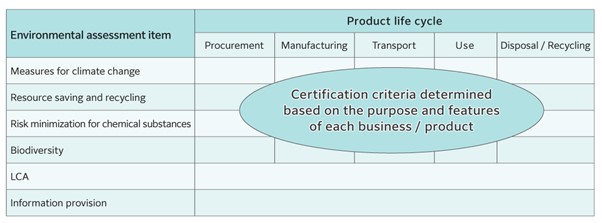
The certification criteria are determined for the entire life cycle of each product with a different weight for each assessment item, by comprehensively assessing the environmental items such as “measures for climate change,” “resource saving and recycling,” “risk minimisation for chemical substances,” and “biodiversity” as well as considering the social requirements for each business/product category.

This certification program is implemented in compliance with the requirements of the international standard “ISO14021 Self-declared Environmental Claims” and obtains the opinions of external experts in order to ensure the objectivity, reliability, and transparency of the program.

Certification ranking and criteria

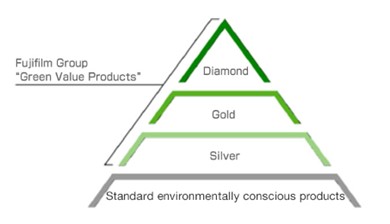
Fujifilm classifies its products into three certification ranks (diamond, gold, and silver) according to the degree of their contribution to the reduction of environmental impact.

RankCertification criteria
DiamondProducts and services that user their respective industries’ innovative technologies to substantially contribute to reducing environmental impact
GoldProducts and services that reduce environmental impact at their respective industries’ highest level
SilverProducts and services that reduce environmental impact at a higher level than their respective industries’ standard

Product examples

In Fujifilm’s Graphic Arts business, the following products have been certified for their environmental performance:

Jet Press 750S High Speed Model:  GOLD

Effects on reduction of environmental impact:

  • Many of the consumables associated with conventional offset printing are eliminated
  • Significantly reduces the amount of wasted paper
  • Smaller footprint compared to previous models
  • The efficient drying mechanism reduces drying times, contributing to significantly higher speeds, and saving power
  • Excellent paper recycleability (de-inking ability)

Overall, there are significant reductions in resources, water use and waste compared to equivalent offset presses, with excellent paper recycling.

Revoria Press PC1120:                      SILVER

The requirements of major environment labels for energy consumption, hazardous substances, audible sound levels during operation and recyclable design are satisfied.

Revoria E1 Series:                             SILVER

The requirements of major environment labels for energy consumption, hazardous substances, audible sound levels during operation and recyclable design are satisfied.

Sustainability targets and the environment

Fujifilm has comprehensive targets relating to sustainability and the environment which lay the foundations for its business management strategies to achieve sustainable growth

Read the article

Reading time: 5 minutes

Fujifilm’s Sustainable Value Plan 2030 (SVP2030)

The Fujifilm Group announced its Sustainable Value Plan 2030 (SVP2030) in August 2017. The new plan set targeting FY2030 as its long-term goal, which is expected to lay the foundations of the Group’s business management strategies for sustainable growth. One of the key pillars of the SVP2030 is dedicated to the environment.

The environment and sustainability

There are four priority issues, regarding the environmental part of the SVP2030, each with its own set of targets:

  1. Address climate change
  2. Promote the recycling of resources
  3. Address energy issues towards a decarbonised society
  4. Ensure product and chemical safety

1. Address climate change

Reduce the Fujifilm Group’s own CO2 emissions

Reduce CO2 emissions across the entire product life cycle*1 by 50% by FY2030, compared to the FY2019 level

So far (2020) the progress is 15%, 29% of the way towards the target


Reduce CO2 emissions from its operations (Scope 1 and 2) *2 by 50% by FY2030, compared to the FY2019 level, aiming to achieve net zero CO2 emissions by FY2040

So far (2020) the progress is 6%, 13% of the way towards the target


Convert 50% of purchased electric power to renewable energy-derived power by FY2030

So far (2020) the progress is 9%, 18% of the way towards the target

Contribute to reduce CO2 emissions in society through the use of Fujifilm’s products and services.

Contribute to a reduction in the CO2 emissions generated by society by 90 million tons by FY2030


Fujifilm has recently increased its target for contributing to reducing CO2 emissions generated in society from 50 million tonnes to 90 million tonnes.  The aim is to achieve this by replacing conventional products with products that are more sustainable.

So far (2020) the progress is 20 million tonnes, 23% of the way towards the target


Increase the % of products certified as “Green Value Products” to 60% of group-wide sales by FY2030.

The Fujifilm Group operates the “Green Value Products” certification scheme, a mechanism for continually creating superior environmentally conscious products and services. In fiscal 2020, 30 new products were certified, bringing the total to 166 (32%), and the company increased the target for the number of products certified to 60% of group-wide sales. As such, Fujifilm is over half-way towards this target.

So far (2020) the progress is 32%, 53% of the way towards the target.

*1 Including phases such as procurement of materials, and manufacturing, transportation, usage and disposal of products.

*2 Direct emission from the company at the manufacturing stage of the product (Scope 1) and indirect emission due to the use of electricity / steam supplied from other companies (Scope 2).

Promote the recycling of resources

Reduce the amount of water the Fujifilm Group uses by 30% by FY2030 (compared to FY2013 levels)

The result in FY2020 was 16%, so the company is over half-way towards the goal of 30% by FY2030.

Contribute to the treatment of 35 million tonnes of water per year in society by FY2030

The result in FY2020 was 8 million tonnes, so the company is around 23% of the way towards the goal of 35 million tonnes by FY2030.

Reduce the amount of waste produced by the Fujifilm Group by 30% by FY2030 (compared to FY2013 levels)

Fujifilm has managed to ensure that the amount of waste produced by the Group did not increase in FY2020, despite rising revenues and an expansion of the business, but has not yet managed to make the reductions planned.  This is a key area of focus for the future.

Achieve a recycling index*3 of more than 10 by FY2030 (was 6.5 in FY2020)

Achieve a valuables conversion index*4 of more than 1 in FY2030 (was 0.63 in FY2020)

*3 Recycling index = (Recycled volume + Valuable-converted volume) / Simple disposal volume

*4 Valuables conversion index = Valuable-converted volume / Recycled volume

Address energy issues towards a decarbonised society

By contributing to the creation and widespread use of renewable energies through advanced materials, Fujifilm aims to help address energy issues and the move towards a decarbonised society. In particular, a New Energy and Industrial Technology Development Organisation (NEDO) started the development of an “all solid state lithium-ion battery” – a next generation storage battery for electric vehicles, under an industry-government-academia collaboration. Fujifilm is participating in the project as one of 23 manufacturers of cars and batteries.

Ensure product and chemical safety

Under this objective, Fujifilm’s aim is to minimise the adverse effect of chemical substances on human health and the environment. In particular, Fujifilm completed the replacement of 2 of 7 chemical substances within the high priority substances for risk management, a new classification established in 2020.  In addition, Fujifilm held online briefings for business partners and achieved 90% understanding of the chemSHERPA chemical information communication system, contributing to further improvement of management accuracy for hazardous substances used in products.

Case Study: Revoria Press PC1120

Arti Grafiche Biellesi

Case Study

The Revoria Press PC1120 investment is Arti Grafiche Biellesi’s first foray into digital print technology after many years producing print on analogue presses.

Arti Grafiche Biellesi

Candelo, Italy

Revoria Press PC1120

Fujifilm has a lot of expertise in this area and we’re excited to work with them and see how our new Revoria investment can help us embark on a new chapter

Alberto Maula | Arti Grafiche Biellesi

Highlights

  • Arti Grafiche Biellesi is an experienced print service provider specialising in high value commercial and packaging applications
  • Following an increase in demand for shorter runs and specialised print jobs, the company invested in Fujifilm’s Revoria Press PC1120
  • Investment marks a switch-over from offset to digital for the company
  • Arti Grafiche Biellesi previously had to outsource work requiring white ink, but can now produce it all in-house
  • The ability to print in special colours, with white ink, and on a wide range of substrates were all key reasons for the investment
  • Arti Grafiche Biellesi is confident that the investment will help the company move forward and address customer demands

Based in the Biella area of Candelo, north-western Italy, Arti Grafiche Biellesi is an experienced print service provider that specialises in a wide variety of printed products. From catalogues to brochures, and from window displays to labels and packaging, the company offers much in the way of versatility and expertise. It is also an adaptable, forward-thinking company and has recently invested in Fujifilm’s Revoria Press PC1120, 120ppm toner-based press – recognising the increase in demand for shorter runs and specialised print jobs. Arti Grafiche Biellesi believes this investment will help the company move forward.

“We print on such a diverse range of materials to produce our products,” explains Alberto Maula, owner of Arti Grafiche Biellesi. “We’re not a conventional print company; 90% of our work is textile-related packaging and packaging for fashion and luxury goods. This involves complicated print jobs on special paper – some coloured, some very thick – these may be cardboard based and have rough surfaces. The end result is products of exceptional quality, and while we have enjoyed much success with our offset equipment, we recognise digital printing to be an increasingly important factor in the evolution of the industry.

With the new Revoria press, we can do print jobs with special colours and print onto a wider variety of substrates with varying thickness. The white ink in particular is remarkable, and the silver and gold also look fantastic.

Alberto Maula | Arti Grafiche Biellese

“We’ve now made our first ever investment in digital printing equipment with Fujifilm’s Revoria Press PC1120. This machine will help us to address the needs of our customers; not just for the creation of more short run jobs, which are now becoming increasingly common, but it will help us to create some incredible print work.”

Colours and versatility were key to the investment. Maula continues: “With the new Revoria press, we can do print jobs with special colours and print onto a wider variety of substrates with varying thickness. The white ink in particular is remarkable and will open a lot of new doors for us – we have had a lot of requests for print jobs with white ink which we had to outsource, up until now. The silver and gold also look fantastic and there are many ways in which we can create some beautiful products for our customers.”

The digital printing market may be new for Arti Grafiche Biellesi, but for Alberto Maula, it’s an exciting journey to embark on: “We are known for offset – we have always been offset. But this move to digital, while mainly an unknown area for us, is full of opportunities. Fujifilm has a lot of expertise in this area and we’re excited to work with them and see how our new Revoria investment can help us embark on a new chapter.”

Taro Aoki, head of digital press solutions at Fujifilm Graphic Communications Europe says: “Arti Grafiche Biellesi knows how to print exceptional work and create some stunning visual products for its customers. We are delighted they see the Revoria Press PC1120 as a crucial part of their business moving forwards.”
Revoria Press PC1120

Find out more about the award-winning features of the Revoria Press PC1120
Discover the Revoria Press PC1120